Slow Practice Isn't Enough: How We Teach Students to Practice
By Choupak Piano Studio
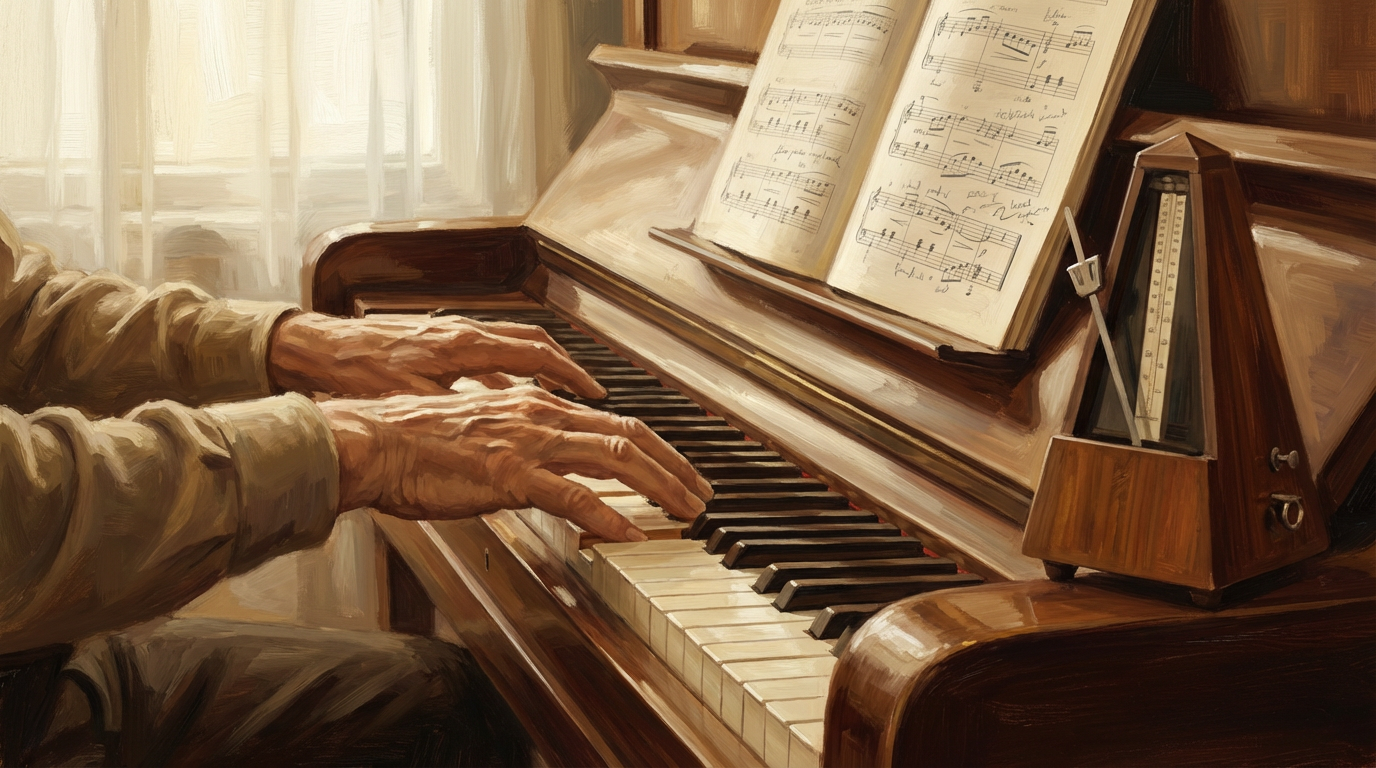
“Just practice it slowly.”
It’s the most common advice in piano teaching, and it’s not wrong — but it’s dangerously incomplete. Slow practice without a clear purpose is just slow repetition of mistakes. A student who plays a passage slowly ten times with the same awkward fingering, the same flat tone, the same mechanical phrasing hasn’t practiced effectively. They’ve just rehearsed their errors at a more comfortable tempo.
In our studio, we teach students not just to practice slowly, but to practice with intention. The distinction matters more than most people realize.
The Problem with “Just Slow Down”
When a student struggles with a passage, the instinct — for the student, the parent, even many teachers — is to reduce the tempo until the notes come out correctly. And there’s value in that. But slowing down only addresses one variable: speed. It doesn’t address why the passage is difficult in the first place.
Is the problem a fingering that creates an awkward hand position at a critical moment? Is it a failure to hear where the phrase is going, leading to tentative, directionless playing? Is it tension in the wrist that compounds as the passage progresses? Each of these problems requires a different solution, and simply playing slowly doesn’t solve any of them.
Diagnose Before You Drill
The first thing we teach students about practice is to stop and think before repeating. When something isn’t working, the question isn’t “can I play it slower?” — it’s “what exactly is going wrong?”
This diagnostic habit is one of the most valuable skills a music student can develop. We work on it explicitly in lessons: isolating the specific beat or transition where a passage breaks down, identifying the physical or musical cause, and then designing a targeted exercise to address it.
A ten-year-old who can say “I keep missing that note because my thumb crosses too late” is a far more effective practicer than a teenager who just runs the passage twenty times and hopes for the best.
Voicing and Listening from the Start
One practice approach that sets the Russian tradition apart is the emphasis on voicing — the ability to bring out one line while subordinating others, even in relatively simple music.
We ask students to practice hands-separately not just for note accuracy, but for tonal control. When a student practices the right hand of a piece, we want them listening to the shape of each phrase: where it rises, where it falls, which notes need more weight, which should recede. When they add the left hand, the question becomes: how do I maintain that phrasing while the other hand plays its own role?
This kind of practice is slower than just running through a piece, but it produces results that repetition alone never will. A student who has worked through a passage with this level of attention doesn’t just play the right notes — they play music.
Sections, Not Run-Throughs
Another habit we build early: practicing in sections rather than always starting from the beginning.
It’s natural for students to sit down and play from measure one every time they practice. The problem is that they end up knowing the opening of every piece beautifully while the middle and ending remain shaky. We teach students to identify the sections of a piece, practice them independently, and then connect them deliberately.
This also means practicing transitions — the two or three beats where one section hands off to the next. These are often the most fragile spots in a performance, and they’re almost always under-practiced because they don’t belong to any single section the student has drilled.
The Metronome Is a Tool, Not a Crutch
We use the metronome, but selectively. It’s useful for building evenness in scales and technical passages, and for gradually bringing a practiced section up to tempo. It’s counterproductive when students use it as a substitute for internal rhythm.
A student who can only play in time with a metronome clicking hasn’t internalized the pulse — they’ve outsourced it. We work on developing a strong inner sense of rhythm through counting, conducting, and singing. The metronome checks their work; it doesn’t do the work for them.
What Parents Can Do
Parents often ask how they can help with practice at home, especially for younger students. A few things make a real difference:
- Protect the practice time. A consistent daily window, free from distractions, matters more than the exact number of minutes.
- Don’t count repetitions — listen for improvement. If your child plays something five times and it sounds the same each time, they’re not practicing effectively. Encourage them to stop and think about what to change.
- Ask what they’re working on, not just what they’re playing. There’s a difference. “I’m working on making the left hand softer in the second section” shows purposeful practice. “I’m just playing my pieces” suggests they might need more structure.
- Trust the process. Thoughtful practice sometimes feels slower than brute-force repetition. The results show up in performance.
Practice as a Skill
The ability to practice well is itself a skill — one that takes time to develop and that we teach as deliberately as we teach scales or repertoire. A student who leaves our studio has more than a collection of pieces they’ve learned. They have a method for learning anything they encounter, at the piano or beyond.
Want to know more about how we structure lessons and practice expectations? Explore our programs or contact us to discuss your student’s needs.